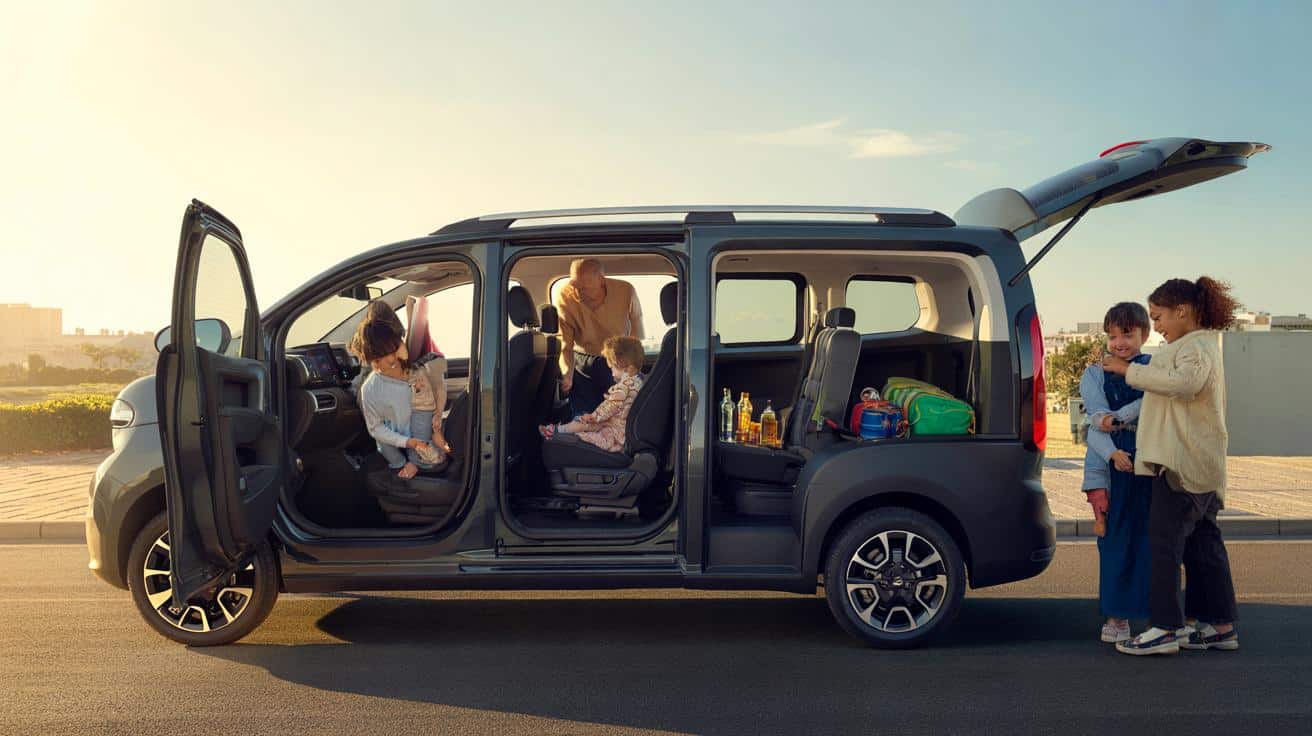
Now a very different seven-seat contender is stepping back into the spotlight, promising living-room practicality, sensible running costs and a layout that feels built around real life rather than showroom gloss.
A compact family box that makes sense again
While most brands chase aggressive SUV styling, Fiat is quietly reviving a more honest format: the compact leisure van. The new Qubo L 2026, revealed for Europe, targets parents who need space, not swagger, and who care more about school runs than kerb appeal.
The concept is simple. Two body lengths are offered. The shorter version stretches to about 4.40 metres and carries five people. The longer model is closer to 4.75 metres and fits seven, including two removable rear seats. The silhouette is proudly boxy, with tall sides and a near-vertical tailgate, prioritising headroom and cargo capacity over aerodynamics-inspired curves.
Sliding side doors on both sides keep access easy in tight spaces. Children can clamber in without dinging neighbouring cars, and carers can fit child seats without contortionist moves in a supermarket car park. Up front, the nose has been softened with LED headlights, a cleaner grille and a prominent Fiat badge, giving the car a more modern, less utilitarian face.
The Qubo L 2026 trades SUV attitude for pure everyday practicality: seven seats, a boxy shape and a family-first layout.
Inside layout: 144 ways to seat the family
Fiat leans hard into modularity. The brand claims up to 144 different seating configurations, and that’s not marketing fluff. Row two is made up of three individual sliding seats that can move, fold or be removed depending on the day’s mission. In the long version, the third row uses two lightweight seats that can either fold into the floor or lift out entirely.
The front passenger seat also folds flat. With that trick, owners can load items of nearly three metres in length – think flat-pack wardrobes, surfboards or planks for a DIY project – without needing a van hire. It turns the car into a part-time delivery vehicle when needed.
Storage that anticipates daily chaos
Beyond the seating puzzle, small-item storage is a big theme. The Qubo L offers 27 separate storage spaces spread across the cabin. There are deep door bins sized for large bottles, hidden cubbies under seats, overhead shelves and closed compartments on the dashboard for valuables.
A large glazed roof option, branded “Magic Top”, floods the cabin with light, making long trips feel less claustrophobic. Optional “Magic Windows” – wide, opening side panes – boost airflow to the rear rows, which children in the third row typically complain about in more enclosed SUVs.
➡️ Wood stove owners: this low-cost little accessory transforms comfort and promises savings
➡️ US Air Force intercepts Russian Il-20M aircraft near Alaska airspace
➡️ This habit helps reduce tension in everyday exchanges
➡️ University degrees are useless how colleges turned into overpriced status clubs
➡️ Why child development experts never use time-outs (the more effective discipline method)
With 27 storage areas and a glass roof option, the cabin behaves less like a car interior and more like a compact living space.
Up front, the dashboard layout keeps things simple. A central touchscreen manages media, navigation and smartphone mirroring, but Fiat keeps physical knobs and buttons for the basics such as temperature and volume. For parents juggling kids, snacks and directions, that kind of tactile redundancy matters.
Engines and power: petrol, diesel and an all-electric option
Under the bonnet, the Qubo L avoids a one-size-fits-all approach. Fiat will offer three main powertrain families tailored to different use cases:
- Petrol: 1.2-litre turbo with 110 hp, manual or automatic, suited to mixed town and motorway use.
- Diesel: 1.5-litre with 100 or 130 hp, aimed at drivers covering long distances who want strong fuel economy.
- Electric: 100% electric motor with 136 hp and a 50 kWh battery, targeting about 300 km of range on the WLTP cycle.
The electric version will initially be available only in the shorter, five-seat body. Rapid charging up to 100 kW is planned, which means a typical 10–80% top-up could be done within a coffee-and-toilet-stop window on a motorway journey, assuming infrastructure co-operates. The battery is packaged under the floor, so boot volume remains broadly similar to the combustion versions.
The fully electric Qubo L focuses on urban and suburban families, offering low running costs without sacrificing boot space.
Why this layout suits changing city rules
Across Europe, more cities are tightening access rules around older combustion engines and rolling out low-emission zones. A compact electric family car that still carries five people and their school sports gear neatly fits this shift. For households not ready to go fully electric, the petrol turbo and efficient diesels keep options open while fuel prices remain volatile.
Pricing and rivals: going against the SUV tide
Fiat’s strategy hinges on cost control. A starting price under €25,000 has been signalled for the entry-level Qubo L, putting it squarely against the likes of the Citroën Berlingo, Renault Kangoo and Opel Combo. Where many SUVs have crept steadily upwards in price, this car aims to stay accessible to families who need function on a realistic budget.
The brand positions the model as an alternative to both compact SUVs and traditional estate cars. Against SUVs, it promises easier access, more flexible seating and a squarer, more useable cargo area. Against long estates, it delivers higher seating for a better view out and sliding doors that make life in busy car parks less stressful.
The Qubo L is designed for families who want space and flexibility, but who refuse to pay SUV money for styling they don’t need.
At a glance: Qubo L 2026 key points
| Feature | Detail |
|---|---|
| Body lengths | 4.40 m (5 seats) / 4.75 m (7 seats) |
| Seating | Up to 7 seats, 144 configurations |
| Engines | Petrol 1.2 (110 hp), Diesel 1.5 (100/130 hp), Electric 136 hp |
| Battery (EV) | 50 kWh, ~300 km expected range |
| Charging (EV) | DC fast charge up to 100 kW |
| Starting price | Under €25,000 (targeted) |
| Launch timing | From mid-2026 in Europe |
How this car fits real family routines
On paper, the numbers look appealing. The true test will be everyday life. For a typical family of five, the Qubo L long version allows all children to travel in individual seats, with ISOFIX mounting points expected on at least the outer positions. Fold one seat in the third row and there is still room for a pushchair or weekly grocery shop without reconfiguring the entire cabin.
Weekend scenarios favour the flexible interior as well. A family heading to a camping trip can remove the third row entirely, slide row two backwards for legroom and still load tents, chairs and bags up to the roof. For grandparents, the high roof and wide door openings simplify access, cutting the awkward bend that comes with low-roof estates.
For parents thinking of switching from a compact SUV, one question looms: will it feel too “van-like”? On that front, Fiat is banking on softer styling, improved sound insulation and a more car-like driving position. While it will never match a crossover for stance, the pay-off in space and practicality could carry more weight for those who treat their car as an all-purpose family tool.
Useful concepts: ludospace, range and running costs
The Qubo L sits in a segment often called “ludospace” in France – literally a playful, leisure-focused space. In practice, that means a vehicle derived from light commercial roots but tuned for passengers, with extra glass, better seats and more tech. These cars rarely grab headlines, yet they often serve as the backbone for large families, tradespeople during the week and adventure seekers at weekends.
Range figures for the electric model also deserve context. An expected 300 km WLTP translates, in real mixed driving with a family on board, to something closer to 220–250 km, especially in winter. For school runs, commuting and local sport activities, that is usually plenty. Long holiday drives will require charging stops, so families will need to check motorway charging layouts along their route when planning trips.
On the cost side, diesel remains attractive for high-mileage drivers, even as some cities start to restrict older diesel models. The latest emissions standards and particulate filters mean modern units are cleaner than the reputation that clings to them. Petrol suits lighter annual mileage with a simpler ownership experience, though higher fuel consumption compared with diesel is the trade-off.
For households weighing all three options, a realistic approach is to map out yearly mileage, regular routes and access to home or workplace charging. A family that owns a driveway and mostly does local travel might find the electric Qubo L slashes running costs. A family in a flat with street parking who travels across the country each month may lean towards diesel for now, using the flexible interior to make long drives more bearable.