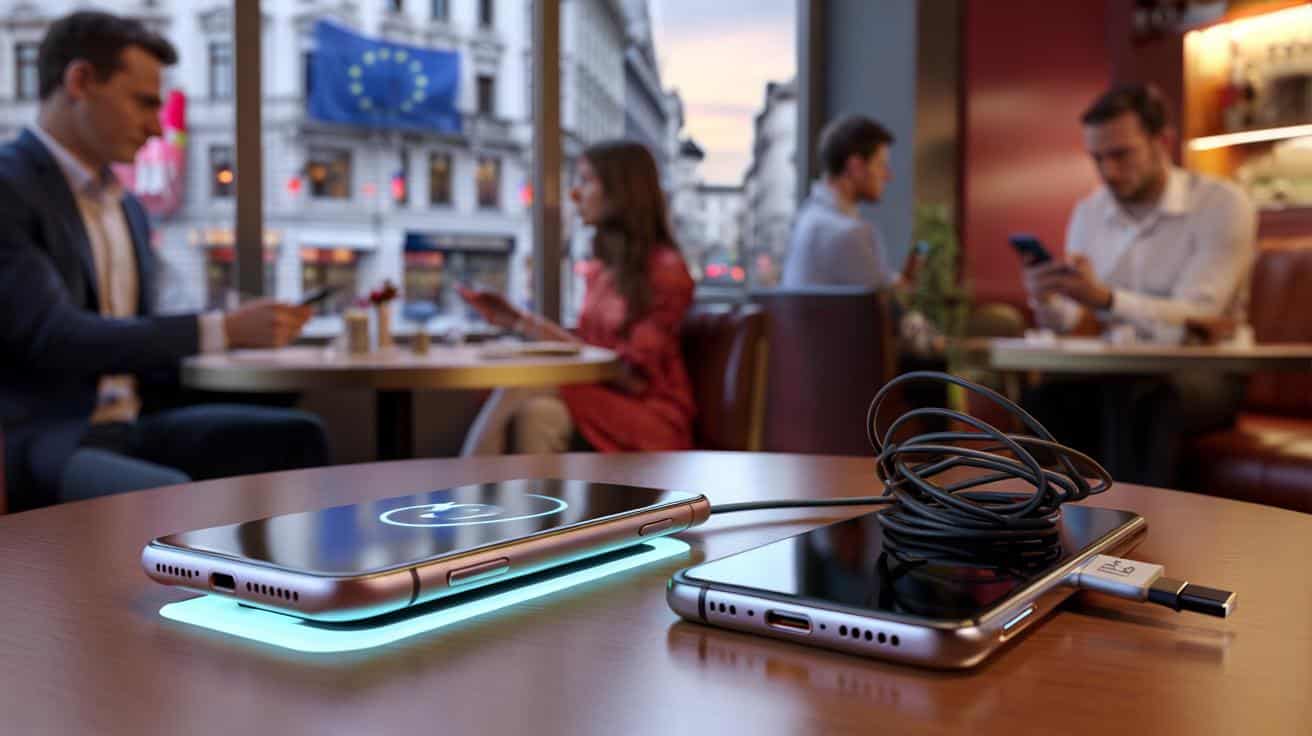
The café was full of people bent over their phones, as usual. One guy at the next table kept twisting a frayed USB-C cable, staring at his battery icon like it was a countdown to disaster. His charger finally lost contact, and you could see the mix of panic and resignation on his face. He looked around for a spare cable, didn’t find one, and ended up moving closer to the wall plug, as if proximity alone might charge his phone faster.
We’re still glued to tiny metal ports and fragile cables, yet in Brussels a very different future is being sketched.
Some people in the room don’t know it yet, but their last cabled phone might already be in their pocket.
Why the EU’s “pro-USB-C” law may be the first step toward no ports at all
On paper, the European Union has forced Big Tech to stick with USB-C for the next wave of smartphones and gadgets. It sounds like a protective move, almost nostalgic: one single cable for everything, easy, universal, less waste, fewer adapters. Tech fans cheered when Apple finally switched the iPhone to USB-C because it felt like a win for users after years of dongle chaos.
Look a little closer and the story changes. This new standard could actually speed up the death of physical ports altogether.
Take Apple. For years, rumors have swirled about a “portless iPhone” with no Lightning, no USB-C, just a slab of glass and metal that charges and syncs wirelessly. When the EU pushed for USB-C, most people expected Apple to fight until the last second. Instead, Apple quietly adapted, almost casually, then doubled down on features like MagSafe wireless charging and seamless iCloud syncing.
It felt less like surrender and more like a transition phase. A polite stopover on the road to a phone that never needs a hole in its frame again.
From a design perspective, a port is a liability. It gathers dust, lets in water, breaks when a cable is yanked sideways. Engineers dream of sealed devices that can survive drops in the sea, sand on the beach and years in your pocket without a weak point. Wireless charging pads are getting more efficient. Wi‑Fi and 5G are fast enough for most backups and file transfers.
So when the EU freezes the hardware chaos into one port, brands can already prepare the next leap: getting rid of that last opening using wireless standards that no regulator can “see” in the same way.
USB-C today, invisible tech tomorrow: how your habits will quietly shift
The first step in this shift is already in your home: stop thinking of your charger as a cable and start seeing it as a surface. Wireless charging pads on bedside tables. Stands on desks. Charging zones in cars and even restaurant chains. You place the phone down, and that’s it. No fumbling in the dark, no upside‑down plug, no bent connector.
➡️ Oral health has a direct impact on life expectancy
➡️ Starlink activates satellite internet on mobile : no installation and no need to change your phone
➡️ Weight-loss injections: the pounds return to baseline in under two years after stopping
➡️ The lazy cleaner’s trick: a few drops in the water and your windows shine like new until spring
➡️ What It Really Means When a Stranger Smiles at You, According to Psychology
Once you start living like that most days, the little port at the bottom of your phone starts to feel less like a necessity and more like a backup. A safety net you barely use.
We’ve all been there, that moment when you’re at a friend’s place, your battery is at 4%, and nobody has the “right” cable. One has an old micro‑USB. Another has a proprietary laptop charger. You’re stuck watching your phone slowly die. Now imagine the same scene five years from now. Instead of asking for a cable, you just ask, “Do you have a charging pad?”
That small social shift changes everything. Accessories become shared “platforms” instead of personal wires. Public spaces can equip tables and shelves with induction zones that work for any compliant phone. Once that habit is ingrained, the argument for keeping a physical port becomes weaker every year.
From the industry side, the logic is brutally simple. Fewer ports mean fewer failure points and fewer warranty claims. A portless phone is easier to waterproof, slimmer to design, simpler to assemble. It encourages you to live in the brand’s ecosystem of wireless earbuds, cloud storage, proprietary fast-charging pads and subscription services.
Let’s be honest: nobody really plugs their phone into a laptop every single day anymore. For manufacturers, that reality is a green light. If most people already live wirelessly, the last port is not a necessity. It’s a compromise they’re preparing to phase out.
How to survive (and even enjoy) a future with no smartphone ports
If you want to be ready for the next wave, think infrastructure, not gadgets. Start by upgrading just one or two strategic places in your life: your nightstand and your desk. Get a reliable wireless charging pad next to your bed where your phone already sleeps. Place another on your main work surface. These two spots alone can completely change your charging rhythm.
You’ll notice your phone sits on power more often, instead of dipping to zero and causing that daily anxiety spiral.
People often jump too fast into the “all wireless, all at once” fantasy and end up frustrated. They throw away cables, buy cheap pads that overheat, and then blame the technology when the experience is bad. Go step by step. Keep a solid USB‑C cable in your bag for emergencies. Use wireless at home and for casual top‑ups, and reserve physical cables for travel, long days out, or big file transfers.
The goal isn’t to be perfect. The goal is to build habits that still work when the port quietly disappears.
*The plain truth is that tech giants will not wait for every user to be ready before dropping the port; they will bet that most of us will adapt on the fly.*
- Start with hybrid gear
Look for accessories that support both USB‑C and wireless charging. They soften the transition and keep you covered in any situation. - Protect your data flows
Before a portless world arrives, set up automatic backups over Wi‑Fi to your cloud service of choice or a home NAS so you don’t depend on a cable for that “one big backup”. - Watch the EU’s next moves
The USB‑C law made headlines, but the real shift will come from how regulators treat wireless standards, e‑waste from chargers and the right to repair sealed devices. - Prepare for repair changes
A fully sealed phone sounds great until you drop it. Ask brands how battery swaps and screen repairs will work once there is no way to plug into diagnostics physically. - Vote with your wallet
If a brand goes portless in a way that traps you in expensive accessories, you can always buy from a rival that offers a more open, user‑friendly path.
What the EU’s quiet tech revolution really means for you
The EU looks like it’s defending the humble cable, but the deeper story is about control. By forcing a single standard, regulators cut down on waste and frustration, yet they also nudge companies toward the only space still free to maneuver: the invisible layer of wireless. That’s where the next battles will play out, away from the metal edges of our phones and inside networks, protocols and ecosystems.
For everyday users, the shift will feel oddly familiar. Less plugging in, more placing down. Less local storage, more clouds humming far away. We’ll gain reliability and convenience, lose a bit of physical grip on our own devices, and keep renegotiating the trade‑off between comfort and control.
The EU is clearing the path without fully knowing where it ends. Brands will sprint ahead. We’ll walk behind, pockets buzzing, wondering when we used a cable for the last time without even noticing.
| Key point | Detail | Value for the reader |
|---|---|---|
| EU standardization on USB‑C | Forces all major smartphone makers to adopt one physical connector in the short term | Less cable chaos now, clearer view of the next transition later |
| Gradual move to wireless ecosystems | Charging pads, cloud backups and wireless data replace most cable uses | Helps you prepare your setup before ports start to disappear |
| Impact on repair, control and daily habits | Sealed, portless devices are tougher but more closed and dependent on ecosystems | Gives you the chance to choose brands and habits that protect your flexibility |
FAQ:
- Will the EU actually allow completely portless phones?There is no specific EU rule that bans portless devices. The USB‑C law applies when a physical charging port exists. If a phone charges only wirelessly, regulators will likely focus on interoperability and safety of those wireless standards rather than demanding a physical connector.
- Are wireless chargers as efficient as USB‑C cables?Not yet in most cases. Cabled charging is usually faster and wastes less energy as heat. That gap is shrinking with new standards and better coils, but if you need the fastest possible charge today, a good USB‑C cable and brick still win.
- What about data transfer without a port?Brands are pushing fast Wi‑Fi, 5G, AirDrop‑style sharing and automatic cloud backups to replace cable transfers. For professionals who move big video files, dedicated wireless workflows or external recorders may become essential once ports disappear.
- Is a portless phone harder to repair?It can be. A sealed chassis is great for durability but can complicate access for independent repair shops. Expect more reliance on software diagnostics over the air, and check a brand’s repair policy before you buy a fully sealed device.
- What can I do now to be ready?Set up reliable Wi‑Fi backups, invest in one or two quality wireless chargers where you spend the most time, keep at least one strong USB‑C cable as a fallback, and pay attention to how open or closed each brand’s ecosystem feels before upgrading your next phone.