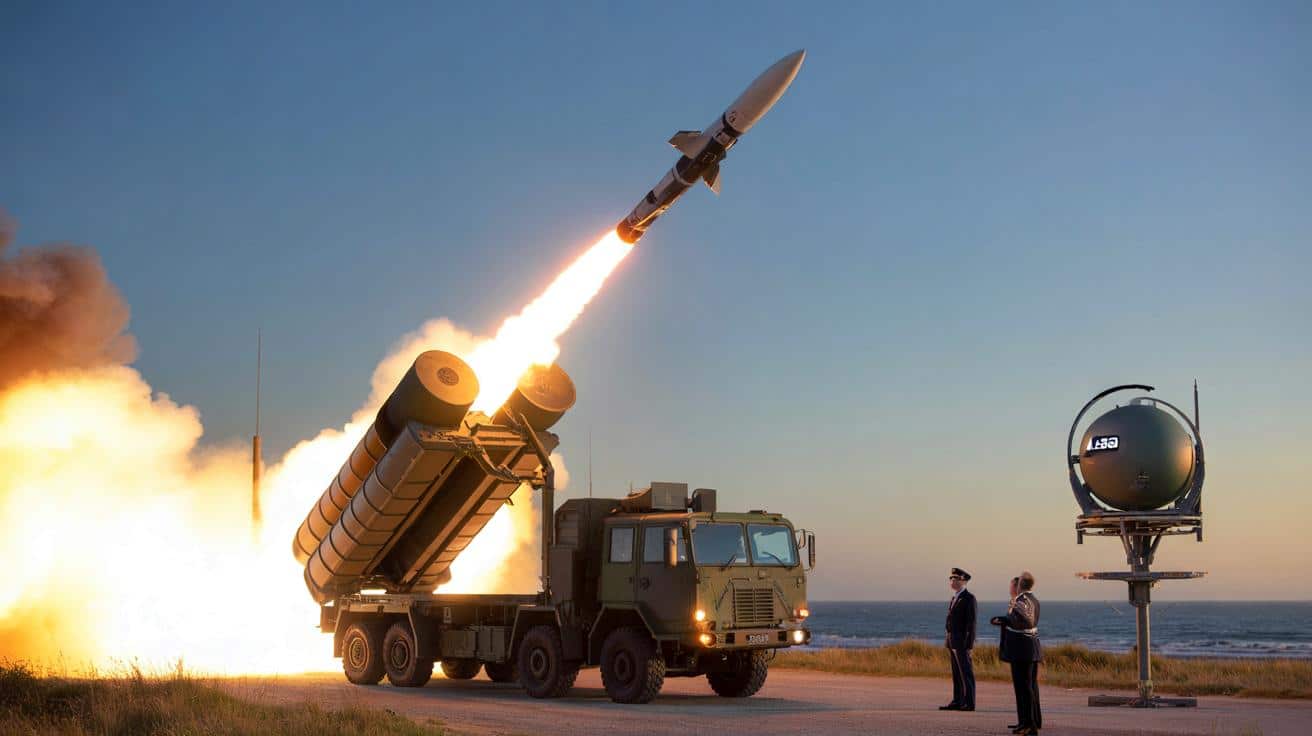
France’s defence establishment has confirmed that a new generation of anti-air missile has passed a crucial live trial, marking a significant shift in how the country plans to protect its skies in the face of faster, more agile aerial threats.
A new chapter for French air defence
The missile in question, the Aster 30 B1NT (for “Block 1 New Technology”), is the latest evolution of a long-running Franco‑Italian programme. It builds on the Aster family of missiles that France and Italy have used since the 1990s to guard warships, bases and strategic sites against aircraft and incoming missiles.
The French defence procurement agency, the Direction générale de l’armement (DGA), announced on 9 October 2024 that the new missile had completed its first qualification firing. The test took place the previous day from the DGA’s missile range at Biscarrosse, on the Atlantic coast in south‑west France.
France and Italy are betting that upgrading, rather than replacing, their Aster missile family will keep their air defences credible against modern threats well into the 2030s.
The Aster 30 B1NT is intended to address a rapidly changing battlefield. Drone swarms, stealthier aircraft and faster ballistic missiles are all forcing militaries to rethink how they protect ground forces, cities and critical infrastructure.
Inside the Biscarrosse test
The DGA released only a short, tightly edited video clip of the firing, citing security concerns. The message was clear enough: the launch was deemed a success and counted as the first qualification shot for both the missile and its associated ground system.
The trial was staged to mimic a difficult real‑world scenario. According to the DGA and reporting from Agence France‑Presse, two target aircraft were used to simulate a complex engagement at around 6,000 metres altitude, some 20 kilometres off the French coast. Both were flying at close to 900 km/h.
One target played the role of an enemy attack aircraft. The second represented a friendly plane that needed to be protected. The missile and its fire‑control system therefore had to detect, track and distinguish between “friend” and “foe” before engaging.
The shot ended with the firing officer reporting that the target had been hit, signalling that the missile had successfully intercepted its mark in a crowded, realistic air picture.
➡️ Drivers receive good news as new licence rules are set to benefit older motorists across the country
➡️ Why people hang a bay leaf on the door and what it’s for
➡️ The EU labels caffeine as potentially harmful if ingested: what that really means
➡️ Why child development experts never use time-outs (the more effective discipline method)
➡️ The pantry mixture that brings burnt baking trays back to life with minimal scrubbing
French armed forces minister Sébastien Lecornu attended the test and later called it a “major step” for national and European air defence, underlining how politically sensitive and strategically significant the programme has become.
How the new missile fits into the SAMP/T NG system
The Aster 30 B1NT is not designed to operate alone. It will serve as the main interceptor for the SAMP/T NG system, the new‑generation version of an existing French‑Italian medium‑range ground‑based air defence platform.
SAMP/T NG (Surface‑Air Moyenne Portée / Terrestre Nouvelle Génération) is being developed to protect both land forces and high‑value fixed sites, such as ports, airbases and major cities. It can be deployed on trucks for mobile operations or fixed around sensitive locations.
- Missiles: Aster 30 B1NT interceptors stored in vertical launch canisters
- Radar: a modern, electronically scanned radar to track multiple targets
- Command post: a fire‑control centre to identify, prioritise and engage threats
- Launchers: truck‑mounted launch vehicles that can be dispersed for survivability
France and Italy aim to field the Aster 30 B1NT within SAMP/T NG batteries from around 2026. The same missile is also expected to equip some naval platforms, providing air and missile defence for frigates and possibly larger combat ships.
What the Aster 30 B1NT can do
Officials remain deliberately cautious about detailing the missile’s exact capabilities. Still, statements from MBDA, the European missile manufacturer behind Aster, outline broadly what the system is designed to handle.
| Capability | Indicative figure |
|---|---|
| Maximum altitude | Up to ~25,000 metres |
| Engagement range | Up to ~150 kilometres |
| Target speed | Up to around Mach 5 (approx. 6,000 km/h) |
| Threat types | Drones, aircraft, cruise and some ballistic missiles |
These figures place the Aster 30 B1NT in the higher end of medium‑range systems. The missile is designed not only to bring down conventional aircraft but also to intercept fast‑moving missiles that arc high into the atmosphere before plunging back towards their targets.
By targeting objects flying at up to Mach 5, the Aster 30 B1NT pushes French and Italian air defences into the realm of ballistic missile interception, not just classic aircraft defence.
French and Italian strategic stakes
For Paris and Rome, the programme has both military and political weight. The war in Ukraine has shown how cruise missiles, drones and ballistic systems can batter cities and power grids far behind the front lines. European states are scrambling to plug gaps in their ground‑based air defences.
France has tended to emphasise strategic autonomy, preferring European‑built systems where possible instead of relying solely on US‑made Patriots or THAAD batteries. The Aster 30 B1NT and SAMP/T NG fit into that logic, offering a European alternative for medium‑range defence.
Italy shares that strategic interest and has already used existing SAMP/T systems in NATO contexts. The upgrade gives Rome and Paris the option to contribute high‑end air defence units to alliance operations, from Eastern Europe to the Mediterranean.
How it compares with other systems
Direct comparisons with foreign systems are always tricky, but broad trends are visible. The Aster 30 B1NT aims to sit roughly in the same performance space as some variants of the US Patriot missile or the Israeli David’s Sling, focusing on medium‑range threats and limited ballistic missile defence.
Unlike very long‑range systems designed to engage targets hundreds of kilometres away, Aster‑equipped batteries are meant to create “bubbles” of protection over specific zones: a city, a naval task group, or a deployed brigade.
What “qualification firing” really means
The DGA framed the Biscarrosse launch as the first qualification firing, a term that can sound opaque outside defence circles. In practice, it signals that the missile and its supporting systems are moving from development into the phase where performance is formally measured against contract requirements.
Engineers look at details that are invisible in a short video clip: trajectory accuracy, communication between radar and missile, timing of target recognition, and how the system copes with clutter and decoys. If repeated tests confirm that performance meets the agreed standard, the missile can be cleared for operational deployment.
Before that point, several more launches are likely, under varying conditions: different altitudes, target profiles, electronic interference and possibly bad weather. Each firing is a data‑gathering exercise as much as a demonstration.
Why terms like “Mach 5” and “ballistic missile defence” matter
Technical jargon can easily obscure what is at stake. Two terms linked to the Aster 30 B1NT are worth unpacking.
Mach 5: This refers to five times the speed of sound. At those speeds, a missile can cover 150 kilometres in a couple of minutes. An air defence system has only seconds to detect, classify, decide and shoot. That is why modern systems rely on high‑speed computers and automated routines, with human operators supervising but not micromanaging every step.
Ballistic missile defence: Ballistic missiles follow an arcing path, leaving the lower atmosphere and then re‑entering at high speed. Intercepting them is harder than tackling a conventional aircraft, because the timing windows are shorter and the target can be very small. A system like Aster 30 B1NT is aimed mainly at short‑range ballistic threats, not the large intercontinental missiles associated with nuclear deterrence.
Possible future scenarios and risks
The most obvious use case for the Aster 30 B1NT is protecting European soil from missile and drone strikes in a crisis. For example, a SAMP/T NG battery deployed near a coastal city could track and engage a mix of cruise missiles and drones launched from ships or aircraft at sea.
Another scenario involves overseas deployments. French forces regularly operate in the Sahel, the Middle East and the Indo‑Pacific. A mobile SAMP/T NG battery, armed with Aster 30 B1NT missiles, could shield a forward operating base or a multinational task force from aerial attack.
There are also clear risks and trade‑offs. High‑end air defence systems are extremely expensive to buy and to maintain, and each interceptor missile costs a significant sum. Adversaries can respond with saturation tactics, using large numbers of cheap drones or rockets to overwhelm limited stocks of advanced interceptors.
That dynamic pushes militaries to think in layers: pairing long‑range missiles like Aster with cheaper guns, short‑range missiles and electronic warfare tools to handle bulk threats. The Aster 30 B1NT is one piece of that broader puzzle, not a silver bullet.