The model in question, the Audi E5 Sportback, has been crowned “Car of the Year 2026” in China and is sold there for roughly what a basic Audi A1 costs in France. Behind that apparently simple fact sits a deep shift in the global car industry, a new strategy from Audi, and a growing pricing chasm between China and Europe.
A car without the four rings, built for China first
The E5 Sportback is officially an Audi, but it does not carry the iconic four-ring badge on its nose. Instead, it wears a new logo created for a China-only range, developed through a joint venture between Audi and local giant SAIC.
This is not a minor branding tweak. It signals a break with the old German playbook of exporting lightly adapted European models to Asia. The E5 Sportback has been designed, engineered and developed in China, by teams focused on Chinese customers first.
The E5 Sportback is the first Audi conceived from the ground up for China, with its own logo and dedicated platform.
This autonomous line aims to match Chinese expectations on styling, tech features and pricing, rather than asking buyers to conform to European tastes. Audi is effectively saying that China is now big enough, and fast-moving enough, to deserve its own dedicated cars.
A sleek electric fastback aimed at demanding buyers
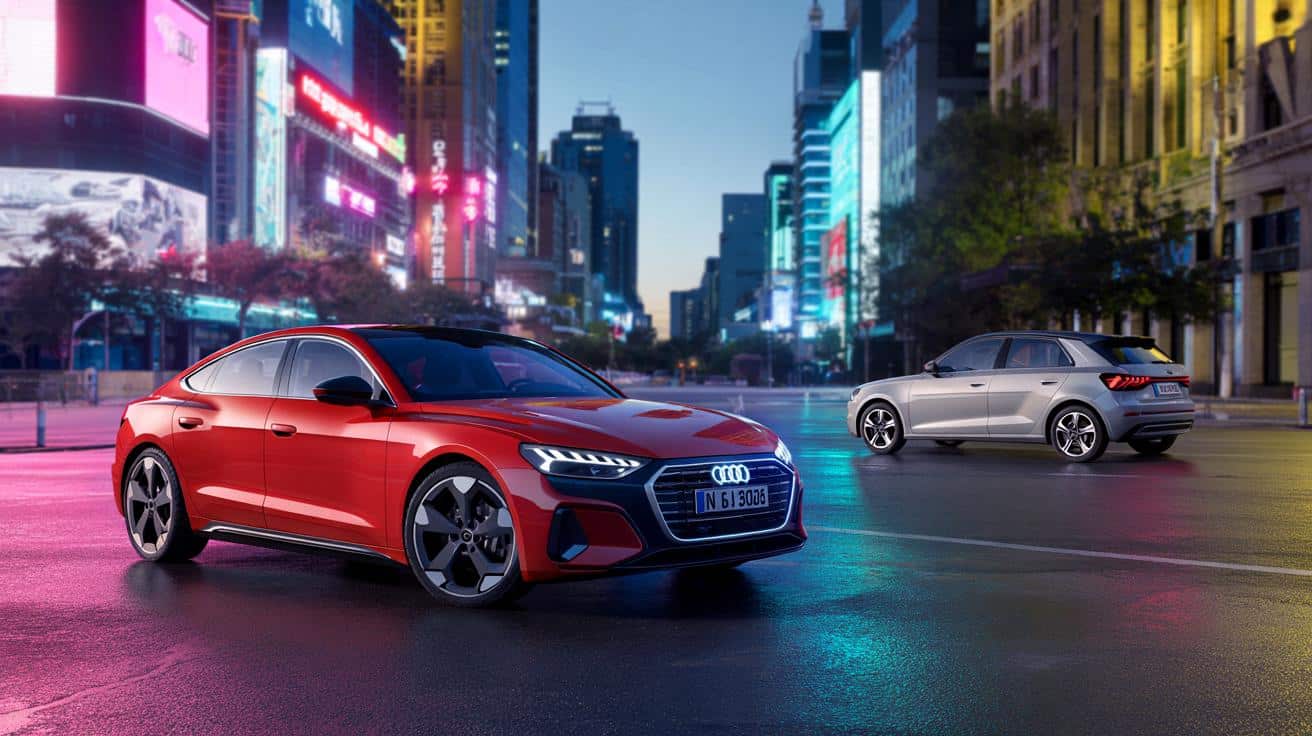
Visually, the E5 Sportback follows the “fastback” template that Chinese premium buyers have embraced: halfway between a saloon and a coupé. The roof drops smoothly towards the rear, the stance is wide, and the overhangs are short. The car looks planted and assertive rather than conservative.
At the front, the traditional Audi grille gives way to a largely closed panel, typical of all-electric cars, framed by sharp LED signatures. At the rear, a continuous light bar stretches across the tailgate, a design cue that is now almost expected in the Chinese premium segment.
Inside, the cabin leans heavily on tech. There is a dual digital display setup, a large infotainment screen, and software tailored to Chinese services and apps. Voice control, online services and in-car entertainment are central to the offering, because buyers in big cities spend hours in traffic and treat the car as a rolling living room.
The interior targets tech-hungry buyers: dual screens, localised apps, and a finish that rivals European premium models.
Materials and assembly quality are described as significantly improved versus previous locally built Audis, reflecting how quickly Chinese plants and suppliers have moved upmarket.
➡️ University degrees are useless how colleges turned into overpriced status clubs
➡️ The plantings experienced gardeners never miss for a flourishing spring orchard
➡️ People who feel emotionally tense in safe environments often learned early vigilance
➡️ The lazy cleaner’s trick: a few drops in the water and your windows shine like new until spring
➡️ Major milestone reached”: France hails success of first test launch of new‑technology missile
A new electric platform with headline numbers
Under that sleek body, the E5 Sportback debuts a new architecture called ADP, for Advanced Digitized Platform. It is a modular base designed for electric powertrains, high computing power and constant software updates.
Audi and SAIC offer several powertrain options, including single-motor rear-drive and dual-motor all-wheel-drive versions. The range-topping variant is where the numbers get eye-catching.
- Maximum power: 579 kW (around 787 bhp)
- 0–100 km/h: about 3.4 seconds (official CLTC figures)
- Claimed range: up to 770 km on the Chinese CLTC cycle
The torque figure has not been published, but acceleration claims put the car firmly in super-saloon territory. The battery capacity has not been confirmed either, though industry observers expect something around 100 kWh, combined with sophisticated thermal management and high-rate DC fast charging.
That 770 km range comes from the more lenient Chinese CLTC test cycle. Translated into European WLTP numbers, the real figure would be lower, but still competitive for a large, powerful EV.
China price versus French A1: the brutal comparison
What really stings in Europe is the price. In China, the E5 Sportback is positioned so that a well-equipped version roughly matches the cost of a base Audi A1 in France – a much smaller, petrol-powered supermini built for entry-level buyers.
| Model | Market | Category | Approximate positioning |
|---|---|---|---|
| Audi E5 Sportback | China | Electric fastback, high performance | Price level of a basic premium small car in Europe |
| Audi A1 (base) | France | Petrol supermini, entry-level | Similar price band to E5 Sportback in China |
This comparison, while not perfectly like-for-like due to taxes, duties and local incentives, illustrates the widening gap. Chinese-built EVs often pack more battery, more power and more tech at a given price point than their European counterparts.
Why the 2026 car of the year title matters
The “Car of the Year” title in China is awarded by a panel of journalists, engineers and industry experts. The jury looks at technology, efficiency, value, safety and market relevance. It is not a simple popularity contest.
By winning it on its first full year on sale, the E5 Sportback sends a strong message. It validates Audi’s gamble to localise development and accept that Chinese tastes can drive the brand’s design and engineering decisions.
The context makes that prize even more significant. China’s EV market is fiercely competitive, with local brands such as BYD, Nio, XPeng and Aito pushing rapid product cycles and ambitious software features. For a foreign premium brand to cut through that noise, it needs more than a badge.
Against BYD, Nio and a wave of new Chinese players, the E5 Sportback winning car of the year signals that foreign brands can still lead – when they adapt.
For Audi, this is also a way of showing shareholders and German unions that heavy investment in China can yield quick, visible results.
What this says about Audi’s global strategy
For now, there is no plan to sell the E5 Sportback in Europe. The ADP platform is geared toward Chinese regulations, infrastructure and supplier networks, and the car’s styling was chosen with Chinese tastes front and centre.
Instead, Europeans get models like the Q6 e-tron and upcoming A6 e-tron, engineered in Germany on different platforms and priced for Western labour costs and regulatory frameworks. Two product universes are emerging inside the same brand.
This split signals a quiet but deep shift. Carmakers used to dream of “world cars” that could be sold, with minor tweaks, on every continent. That strategy is fading. Local regulations, subsidies, consumer expectations and economic realities are drifting apart, and product lines follow.
Why Europe feels left behind
For European drivers, especially in countries like France where energy prices and taxes are high, the Chinese E5 story can be frustrating. They see a large, advanced EV available at the price of their smallest Audi, yet out of reach due to policy and industrial choices.
Several factors play into this gap:
- Lower production costs and localised supply chains in China
- Massive domestic competition forcing aggressive pricing
- Different tax structures and EV incentives
- Higher labour, energy and compliance costs in Europe
European governments are responding with tariffs and industrial plans to support local EV production. That might protect jobs, but it also risks keeping prices higher for longer, while Chinese buyers access faster innovation at lower cost.
Key terms and concepts behind the story
Two ideas help explain what is happening here: “platform” and “joint venture”. A platform, in automotive language, is the set of core components that underpin a car – battery layout, chassis, electronics, software backbone. The ADP platform of the E5 is designed for heavy digital integration and frequent software updates, similar to how smartphones now receive regular feature upgrades.
A joint venture is a legally separate company created by two or more firms. In China, foreign carmakers often team up with local manufacturers to access factories, networks and regulatory approvals. The Audi-SAIC partnership allows Audi to move faster, source more components locally and tune products more tightly to Chinese expectations.
What this could mean for future European Audis
The E5 Sportback may never cross into European showrooms, but it can still influence what you see on UK or EU roads. Audi’s Chinese products act as a rolling laboratory: new user interfaces, in-car apps, battery chemistries and manufacturing methods can be tested at scale in China, then selectively introduced in Western models.
One plausible scenario in a few years is a European mid-size Audi EV that quietly borrows its software stack or electrical architecture from today’s China-only E5. The badge and exterior style might feel familiar, but underneath, the car could share more DNA with the Shanghai-developed fastback than with any current German-built model.
For buyers, this split path brings both risks and benefits. There is a risk of frustration as they see more value and innovation offered elsewhere at lower prices. Yet there is also a potential upside: pressure from Chinese competition, and from Audi’s own Chinese projects, can push European cars to gain range, performance and software sophistication faster than they otherwise would.
In the meantime, the fact remains: in China, a cutting-edge electric Audi fastback with nearly 800 bhp and 770 km claimed range costs about the same as a basic Audi A1 in France. That single comparison says a great deal about where the gravity of the car industry is shifting – and who currently gets the best deal.