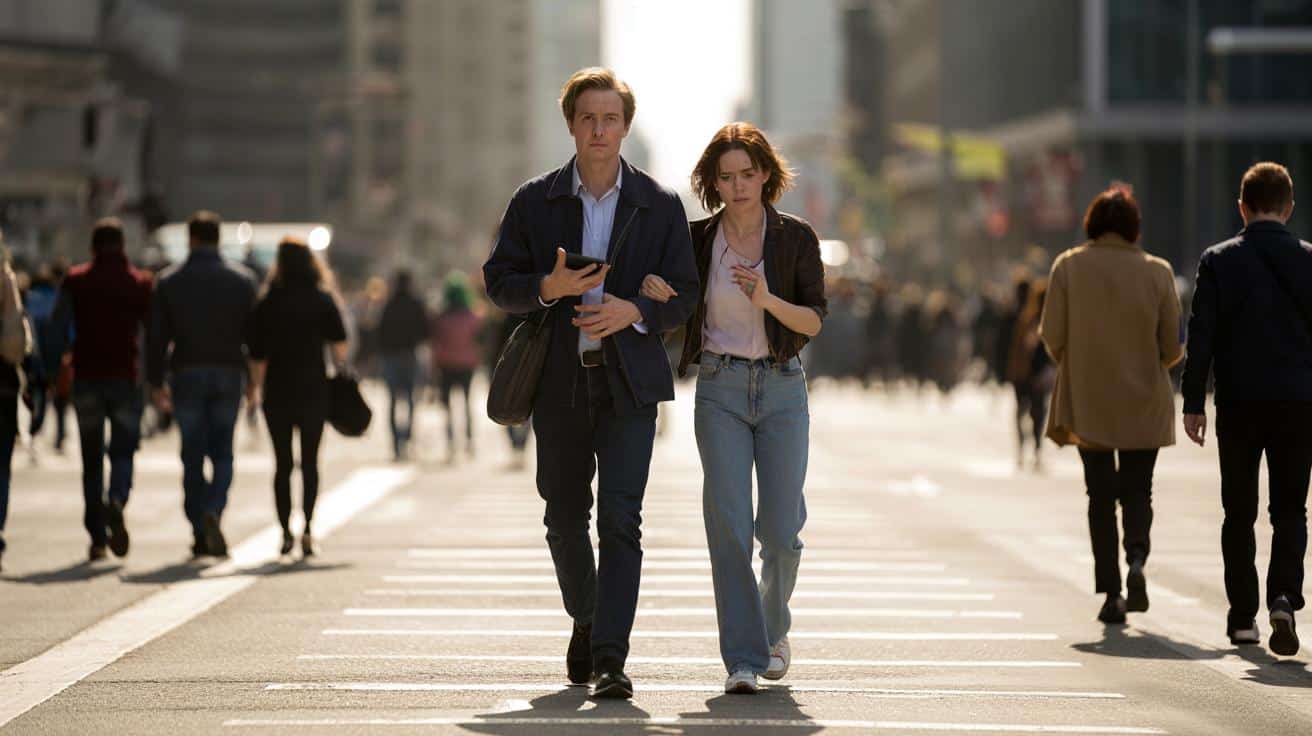
You’re walking down the street with someone you know. Maybe it’s your partner, a colleague, a friend. At first, you’re side by side. Then, slowly, they drift forward. Half a step. One full step. Suddenly you’re behind, looking at their back, talking to their shoulder blades. You feel a tiny pinch in your chest you don’t fully name. Are they in a rush, or are you just… less important right now?
You speed up to catch them, then slow down again, trying not to look needy. They don’t notice. Or they pretend not to. The path feels different when you’re trailing someone instead of walking with them. The whole dynamic shifts, silently.
That tiny distance is not just about legs and pace. It’s about power, attention, emotion. And once you start seeing it, you can’t unsee it.
When walking ahead becomes a quiet power move
There is a reason body-language experts love to observe people walking together. Walking is like a live, moving x-ray of a relationship. When one person consistently walks ahead, it sends a non-verbal message: “I set the pace. I lead. You follow.” Sometimes it’s harmless habit. Sometimes it’s not. The gap between two people can tell you who feels entitled to space and who is expected to adapt.
We rarely talk about it, but our bodies negotiate status long before our mouths say anything. A person who strides ahead without looking back often occupies the “driver” role in daily life. They decide where you’re going, how fast you’re getting there, and whether you’re allowed to catch up.
Picture a couple in a supermarket. He rushes through aisles, cart in front, eyes on his list. She trails behind, stopping to look at a product, then jogging a little to close the distance. He calls out from the end of the aisle, “Hurry up, we don’t have all day.” People glance. She laughs it off, but her shoulders drop a little. On paper, it’s nothing. In her body, it’s something.
Or think of the boss leaving a meeting room, already halfway down the hallway while the intern and junior staff scramble behind, clutching laptops. Nobody said, “I’m more important than you.” The bodies did the talking. This pattern shows up in families, couples, offices, even among friends in a mall. Once you notice who always leads the walk, you start seeing the same script in other areas: who chooses the restaurant, who talks more, whose schedule rules.
Psychologists often connect this to dominance, attachment style, and attentional focus. A person who habitually walks ahead might be more self-focused in that moment, more anxious to “get things done”, or simply less tuned in to other people’s needs. *The body goes where the mind is.* If their mind is always three steps ahead, their stride follows. From a social-psychology angle, walking position subtly encodes hierarchy. Side by side signals partnership, ahead/behind signals leader/follower. Neither is automatically toxic, but when the “leader” never glances back, you get a quiet pattern of disregard. The distance in steps becomes a distance in emotional presence.
When walking ahead means anxiety, not arrogance
There’s a softer side to all this. Someone speeding ahead can also be battling their own nervous system. People with social anxiety or sensory overload often walk faster to escape crowded sidewalks or noisy spaces. They’re not trying to dominate you; they’re trying to get somewhere that feels safer. A fast walker might look rude, yet inside they’re just counting breaths and scanning exits. The body rushes to calm the brain.
Another scenario: the “task mode” walker. This is the person whose brain flips into mission mode the moment you step outside. The goal is the cafe, the train, the store. Conversation becomes secondary. They cut through slow groups, dodge strollers, and you trot behind, half talking to yourself. It’s not that you don’t matter. In their head, the errand currently matters more than the bond.
➡️ What it means to make your bed the moment you wake up, according to psychology
➡️ People who feel emotionally tense in safe environments often learned early vigilance
➡️ Put A Lemon Slice In Your Cold Oven : Why People Are Doing It And When It Actually Helps
➡️ The ocean on Mars was as vast as Earth’s Arctic Ocean
➡️ Fast walkers aren’t more successful, but they do process time differently
Think of the friend who always walks ahead in a busy city. You’re weaving through people, trying not to lose them. They text, look at maps, check the time. If you say, “Can you slow down?” they do… for two minutes. Then the pace creeps up again. This isn’t necessarily contempt. It can be stress, perfectionism, or a learned habit from growing up in a fast-paced environment. Their body simply doesn’t know what “strolling” feels like anymore. Still, your experience matters too. Because you’re not just walking with their feet, you’re walking with their priorities.
That’s the logical tension here. One person’s coping mechanism can feel like another person’s rejection. The same behavior can be rooted in efficiency, fear of being late, or simple distraction. Context matters. Do they walk ahead only in crowds, or always, everywhere, even on a quiet Sunday walk? Do they regularly look over their shoulder to check on you, or do they forget you’re there? The meaning sits in the pattern, not in one isolated walk.
How to respond when someone keeps walking ahead of you
A useful first move is very simple and very physical: change your own pace on purpose. Instead of automatically speeding up to match them, try staying at your natural rhythm. Notice what happens. Do they turn around and adjust to you? Or do they keep going and only realize you’re far behind once you stop following? That tiny experiment tells you a lot about how tuned in they are. Your stride becomes a boundary instead of a silent sacrifice.
Then, name the moment out loud in a neutral tone. Something like, “When you walk ahead of me like that, I feel left out,” lands better than “You’re so rude.” You are not judging their character, you’re describing your experience. That small linguistic shift lowers their defensiveness and raises the chances that they actually hear you.
Many people swallow this feeling for years. They tell themselves, “It’s just walking, I’m being dramatic.” Yet over time, the micro-hurt piles up. You start reading the walk as proof that you always come second. The common mistake is waiting until you’re boiling over to say anything. Then it comes out during a fight: “You even walk in front of me like I’m a child.” The other person is shocked, because nobody gave them feedback earlier. Let’s be honest: nobody really tracks their pace every single day without being prompted.
If you’re the fast walker, you might feel attacked when someone brings it up. Breathe. This is not about blaming you for existing. It’s a chance to ask, “What pace feels good for you?” That question alone shifts the walk from a solo race to a shared activity. You don’t need to walk in lockstep, just in awareness.
“Every step between two people is a tiny vote for how their relationship feels,” says one relationship therapist I spoke with. “The more often they turn back to each other, literally and emotionally, the safer it becomes to walk together through harder things.”
To turn that into daily practice, you can play with simple, almost childlike gestures:
- Occasionally offer your arm or hand when you start walking.
- Check in once in a while: “Am I going too fast for you?”
- Pause at crossings and wait together, even if you could rush ahead alone.
- When you notice yourself speeding, take one deep breath and slow one notch.
- Use walks as a time for side-by-side conversation, not just transport.
These are not grand romantic gestures. They’re small, repeated messages: “We’re on this path together.” One plain gesture of slowing your stride can say what a 20-minute speech would complicate. And yes, sometimes you will forget and rush ahead again. That’s normal. The point isn’t perfection. The point is noticing, returning, and showing that the relationship matters more than the destination.
Reading the gap… without over-reading the gap
Walking ahead can mean a lot of things: control, stress, habit, self-absorption, anxiety, cultural pace, personality. It can also mean nothing on a given day. That’s the tricky territory of body language: it invites interpretation, but not always accurate interpretation. The risk is turning every two-meter distance into a full psychological diagnosis. The real skill lies in holding curiosity. You observe the pattern, you feel your feelings, you ask, you listen. Then you decide what kind of relationship dynamic you want to keep walking in.
Sometimes, a simple conversation shifts years of silent resentment: one person learns to glance back, the other learns to speak up. Sometimes, you realize you’re always the one jogging to catch a person who never waits. That insight hurts but clarifies. You get to choose: stay in that role, renegotiate the pace, or slowly step away. The sidewalk becomes a mirror. How you walk together says something raw and honest about how you live together. And once you’ve seen that, your next walk with anyone might feel very different.
| Key point | Detail | Value for the reader |
|---|---|---|
| Body language of walking | Who walks ahead, who follows, and who adjusts sends subtle messages about power and attention. | Helps you decode relationship dynamics without a single word spoken. |
| Context and patterns | The meaning of walking ahead depends on when, where, and how often it happens, plus whether they look back. | Prevents you from overreacting to one moment while still honoring ongoing patterns. |
| Practical responses | Slowing your pace, voicing how you feel, and adding small connecting gestures can reset the dynamic. | Gives you concrete tools to feel more respected and connected on everyday walks. |
FAQ:
- Is walking ahead always a sign of disrespect?Not always. It can signal dominance or disregard, but it can also come from habit, anxiety, or being task-focused. Look at the pattern over time and whether the person responds when you ask them to slow down.
- What does it mean if my partner never walks beside me?It might reflect a broader imbalance: they lead, you adapt. It can also show emotional distance. Talk about how it feels for you and notice if they’re willing to adjust. That response tells you more than the walk itself.
- How can I bring this up without sounding petty?Stick to your feelings and the specific behavior: “When you walk ahead, I feel left behind,” instead of “You don’t care about me.” A calm moment, not mid-argument, is the best time for this conversation.
- Could fast walking just be a personality trait?Yes. Some people naturally walk fast or grew up in environments where speed was normal. A trait becomes a problem only when it constantly overrides other people’s comfort and they refuse to adapt at all.
- What if they laugh it off when I say something?Notice that reaction. You can gently insist: “I’m serious, it really does affect how I feel with you.” If they still dismiss it, the issue isn’t walking speed anymore, it’s how much they value your emotional experience.