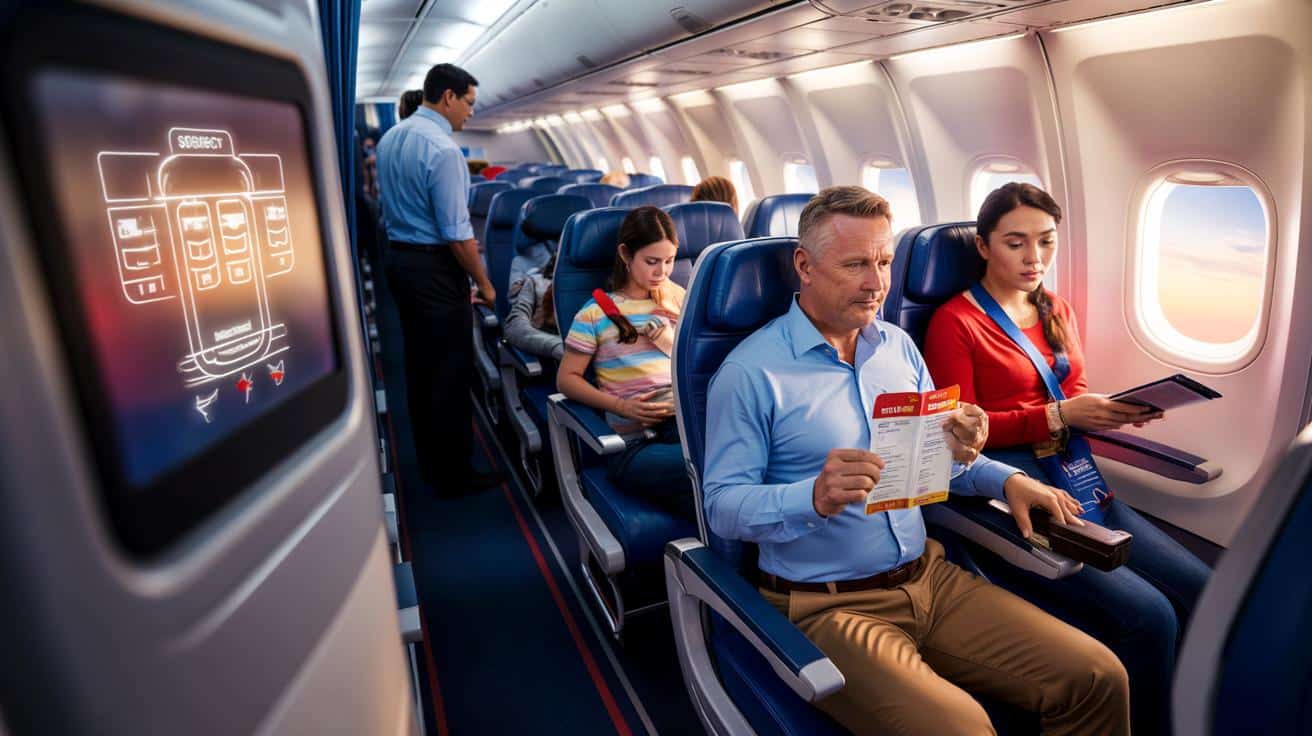
For the first time since the 1970s, Southwest passengers will no longer play the “seat lottery” at the gate. Assigned seating, new fare bundles and fresh rules for larger travellers mean the airline’s famously simple model is getting a much more conventional makeover – with winners and losers on price and comfort.
Why Southwest is walking away from open seating
For decades, Southwest built its identity around a casual, queue-based boarding system. You checked in early, grabbed an A, B or C boarding position, and then rushed on to claim your preferred seat. No seat map, no pre-assigned rows.
That system is now being retired. From Tuesday, Southwest will move to assigned seats across its network of more than 100 destinations, a fundamental change to how the airline works.
Southwest’s own research suggests eight in ten existing customers, and an even higher share of potential customers, prefer assigned seats.
The airline admits it has been losing business to rivals such as Delta, United and American, where choosing a specific seat – or at least knowing it in advance – is standard. When passengers stop flying with Southwest and switch to another carrier, the airline says open seating is the top complaint.
What the new fare bundles look like
Assigned seating is arriving alongside four fresh fare types: Basic, Choice, Choice Preferred and Choice Extra. They replace the old, more uniform model and add layers of perks and restrictions.
Quick comparison of the new fares
| Fare type | Seat | Bags included | Extras | Cancellation credit |
|---|---|---|---|---|
| Basic | Standard seat assigned at check-in | Checked bags paid | Pay for wi-fi and premium drinks | Flight credit valid 6 months |
| Choice | Standard seat, typically further back, chosen at booking | Checked bags paid | Pay for wi-fi and premium drinks | Flight credit valid 12 months |
| Choice Preferred | Standard legroom, further forward in the cabin | Checked bags paid | Priority lane boarding; extras paid | Flight credit terms similar to Choice |
| Choice Extra | Extra legroom, usually in first five rows | Two checked bags | Priority lane, premium drink on many flights, free wi-fi | Flexible credit conditions |
Exact prices will vary by route, demand and travel date, but Southwest says the top-tier Choice Extra could cost roughly twice as much as a Basic fare on the same flight.
What each fare type really means for passengers
Basic: cheapest upfront, least control
Basic is the entry-level option aimed at price-sensitive travellers.
- You do not choose a specific seat when you book.
- The system assigns you a standard economy seat at check-in.
- If you cancel, you receive a travel credit valid for six months.
- You pay extra for checked bags, premium drinks and wi-fi.
For solo travellers on short flights, this might work fine, but families wanting to sit together could face uncertainty unless they pay for a higher fare.
➡️ How emotional investment increases sensitivity to small changes in behavior
➡️ The lazy cleaner’s trick: a few drops in the water and your windows shine like new until spring
➡️ What it really means when someone walks ahead of you, according to psychology
➡️ Fast walkers aren’t more successful, but they do process time differently
➡️ Psychology identifies 9 common phrases self-centered people often use in everyday conversations
➡️ How a drop of washing-up liquid in the toilet can have a surprisingly big impact
Choice and Choice Preferred: more certainty, moderate perks
Choice fares allow you to select a standard seat, typically located toward the rear of the aircraft, during the booking process. If your plans change, you get a credit that lasts for a year instead of six months.
Choice Preferred adds a strategic advantage: seats further forward and access to priority lane boarding. That combination can cut connection stress and speed up your exit on arrival.
For frequent business travellers, being in the first half of the cabin and reaching the door sooner may prove worth the extra cost.
Both Choice and Choice Preferred passengers still pay for checked luggage, premium alcohol and in-flight internet.
Choice Extra: extra legroom and a more “premium” feel
Choice Extra is where Southwest edges closest to a quasi-premium economy experience, while still keeping a single-cabin layout.
The airline has been refitting its all-Boeing 737 fleet since May 2025, partly to accommodate extra legroom seats. These are placed in the first five rows and can offer up to about five inches more pitch, depending on the specific 737 model on the route.
Choice Extra includes:
- Extra legroom seat near the front of the plane
- Two checked bags at no additional cost
- Access to priority security and boarding lanes, where available
- One “premium drink” on flights of 251 miles or more
- Complimentary in-flight wi-fi
On longer domestic routes, that combination moves Southwest closer to what some legacy airlines market as “Main Cabin Extra” or “Economy Plus”.
What changes for plus-sized passengers
The shift to assigned seating also affects travellers who need extra space.
Previously, plus-sized passengers had two options for obtaining a second seat under Southwest’s long-running “customer of size” approach: request an additional seat for free at the airport, or purchase an extra seat in advance and request a refund after travel.
That first route – asking for a free extra seat on the day – is being closed. Passengers now must pre-book and pay for an additional seat, then apply to have the cost refunded afterwards if they meet the criteria.
Spontaneous same-day requests for a complimentary second seat are no longer on the table, which could make trips more costly upfront.
For budget-conscious travellers who need extra room, the change means higher initial outlay and more planning, even if the refund eventually arrives.
How this will change the Southwest experience
From a practical perspective, boarding is likely to feel less chaotic. With seat assignments, the incentive to line up 45 minutes early or obsess over check-in time will fade for many passengers.
On the other hand, some long-time Southwest loyalists valued the freedom to grab any open aisle, pair up easily with friends, or snag desirable seats without paying a specific surcharge.
Families and groups may see benefits, especially if they are willing to pay for Choice or Choice Preferred to lock in seats together. Basic buyers could still end up split if the flight is nearly full and assigned seats scatter them around the cabin.
How to choose the right fare for different scenarios
For travellers trying to adapt to the new structure, a few scenarios might help:
- Weekend city break, carry-on only: Basic may be enough, since you avoid checked bag fees and can tolerate a random seat.
- Family holiday with children: Choice or Choice Preferred gives better control over seating together and slightly more security if plans change.
- Tall passenger on a cross-country flight: Choice Extra’s extra legroom and front-row placement may justify the higher fare.
- Frequent business flyer: Choice Preferred or Choice Extra aligns better with tight connections and productivity, thanks to priority lanes and, in the top tier, included wi-fi.
Key terms and what they actually mean
Two bits of airline jargon matter here: “pitch” and “credit”.
Pitch is the distance from a point on one seat to the same point on the seat in front. It is a rough stand-in for legroom. Southwest’s extra legroom seats add up to about five inches of pitch, which can make a noticeable difference for taller travellers, especially on flights over two hours.
Flight credit is not cash. It is a voucher you can use on a future journey. With Basic fares, the credit expires after six months. With Choice, you generally have up to 12 months. Travellers who book far in advance should pay attention to these dates when choosing a fare, in case their plans change.
Risks and benefits for price-sensitive travellers
The new structure introduces a classic trade-off. There is more choice and more clarity over where you sit, but also more ways to spend extra money.
Those who used to game the old open seating system by checking in early and avoiding fees may feel squeezed. Paying for a specific seat, checked bag and wi-fi could push total costs higher than in the past, especially on busy routes.
On the positive side, passengers who dislike uncertainty now gain something they long wanted: knowing their seat in advance. For nervous flyers, older travellers or anyone coordinating connections, that predictability can be worth paying a modest premium.
Southwest is effectively betting that the loss of some bargain hunters will be offset by newcomers who previously ruled out the airline due to its boarding scrum. How that balance plays out will depend on how closely final ticket prices match the headline promises – and how smoothly the assigned seating rollout works in real life.